
Friday, January 15, 2010
Film Camera or Defender of the Universe
Is it a mid 80s 110 camera or a robot? It's both! Even better (according to the comments), there were several different models. I'll be on the search for one of my own. Thanks to Gizmodo for finding it.

Thursday, January 14, 2010
The Way Back Machine Strikes Again
Here are a couple more images from my original portfolio. I don't remember the cameras or films I used, but I do love these images. The first is my godson about 7 years ago. The second is a beach near my grandmother's house in Florida.


Thursday, January 7, 2010
Wild(s) Bridal
I had the great pleasure of photographing a former bride in her dress once again. Many call them trash the dress sessions, but I just think of them as bridals without worrying about the dress. Ashli chose her grandfather's farm in Gordon for her session. It was perfect! It had open fields, old fences and even a very old car. And for those who ask, this is why I like shooting film. Here are a few of my favorites.
Photographer's Note: The color images are from the Mamiya 645 AF with the 80mm lens on Fuji 400H film. The first B&W image is from my Zeiss Ikon Nettar 6x9 camera (made about 1950) on Kodak Tmax 400. The Second B&W is from my Nikon FM with 50mm f1.8 lens on Ilford SFX 200. The Ilford film is near infrared. I used a R72 filter to enhance the effect. The scans were done on a Epson V500 I borrowed from a friend.


Photographer's Note: The color images are from the Mamiya 645 AF with the 80mm lens on Fuji 400H film. The first B&W image is from my Zeiss Ikon Nettar 6x9 camera (made about 1950) on Kodak Tmax 400. The Second B&W is from my Nikon FM with 50mm f1.8 lens on Ilford SFX 200. The Ilford film is near infrared. I used a R72 filter to enhance the effect. The scans were done on a Epson V500 I borrowed from a friend.


Tuesday, January 5, 2010
Specialize
You might know Jeff Bridges from The Big Lebowski, but I bet you didn't know he was an avid photographer. That wouldn't make him special, though. Photography is one of the most popular hobbies in America. What makes Jeff Bridges special is his devotion to a single camera. If it were a Leica or a Hasselblad, he wouldn't be special. Jeff Bridges camera of choice?
Widelux made several versions of their swing-lens panoramic cameras, but Brides uses a 35mm version to capture behind-the-scenes images from movie sets. He as even released a book of the images. His website includes information about his film career as well as his love of the Widelux. There are examples of his work as well as information about using the Widelux. It is very interesting to see someone so committed to such a special area of photography.
Tuesday, December 29, 2009
A Little "Instant" Gratification
I thought I'd share a few instant images on Fuji instant pack film from my Polaroid 600 SE. These are from a bridal/trash the dress session from last week. I photographed Ashli's wedding a few years ago and she was kind enough to be a guinea pig for my film exploration. We drove to Gordon to her grandfather's farm and it was totally worth it. The rest of the film is in California, but I'll post it as soon as it is back. If these are any indication, the film should rock!


And, just in case no one has come up with this, here is a great way to recycle your Fuji pack film cassettes. I use them as a frame to display my favorite image from the set. It is, of course, the perfect size!

Friday, December 18, 2009
Analog Isn't Dead
When you start down the path to crazy, you find there are many others on the path with you. There is a large community of film nuts all trying to save their beloved medium of choice. Some are even finding new ways to create images using analog technology.
One such person is Aaron Muderick. He has created a technique to create negatives from instant Fuji film. You might wonder why this is important. Simply, you can create a 3x4 inch negative without a darkroom using only normal household items. Here is a link to the Inside Analog Photo podcast where he details the process. You can also see examples here and here.
I'll post some examples once I give it a try.
One such person is Aaron Muderick. He has created a technique to create negatives from instant Fuji film. You might wonder why this is important. Simply, you can create a 3x4 inch negative without a darkroom using only normal household items. Here is a link to the Inside Analog Photo podcast where he details the process. You can also see examples here and here.
I'll post some examples once I give it a try.
Friday, December 11, 2009
I Mean Old School
I found this post this morning on the blog of A Bryan Photography. It is an 8mm movie shot at a recent wedding. That would have been cool enough, but it shows the photographer shooting the groomsmen with what appears to be a Speed Graphic! (Look at about the 2:30 mark on the video.) That is commitment to the analog medium.
Our Wedding from Caleb Chancey on Vimeo.
Our Wedding from Caleb Chancey on Vimeo.
Wednesday, December 9, 2009
Brilliant Inspiration
I found this throught Tim Gruber's wonderful blog. Unfortunately, the link to the original post doesn't work, but I found another copy of it on Frank Chimero's blog. (Frank includes really cleaver illustrations along with the text.)
It is a list of 10 principles that can either make your work better or worse. I'm not sure how they could make it worse. These principles are powerful and I found them very appropriate to my return to film. Here are a couple of my favorites, but follow the links to read them all. Then do them all.
8. Being too comfortable is dangerous. Most creatures die in their sleep. Keep moving, or get eaten. The only things you should be absolutely comfortable with in your creative process are your tools.
9. There is nothing keeping you from doing the sort of work that you wish.What do you want? It’s a hard, yet crucial question. We all do creative work to get happy. It’s why we let it beat us up, and it’s why we keep crawling back to it. Figure out precisely what you want, and realize that if no one will pay you to make it, you can still make it for yourself. And you still win, because you’re happy.
It is a list of 10 principles that can either make your work better or worse. I'm not sure how they could make it worse. These principles are powerful and I found them very appropriate to my return to film. Here are a couple of my favorites, but follow the links to read them all. Then do them all.
8. Being too comfortable is dangerous. Most creatures die in their sleep. Keep moving, or get eaten. The only things you should be absolutely comfortable with in your creative process are your tools.
9. There is nothing keeping you from doing the sort of work that you wish.What do you want? It’s a hard, yet crucial question. We all do creative work to get happy. It’s why we let it beat us up, and it’s why we keep crawling back to it. Figure out precisely what you want, and realize that if no one will pay you to make it, you can still make it for yourself. And you still win, because you’re happy.
Thursday, December 3, 2009
Straight From The Wayback Machine
Here are a couple of images from my original portfolio that I'm not embarassed to show. I actually think they held up pretty well.
The first is an iris I photographed on 35mm film with my Canon Elan II. I lit it with a work light from Lowes. I was so pleased because it looked like I envisioned it. It still hangs in my living room at home.

This is a portrait of a friend of a friend. It was taken with my Elan II at Rose Hill Cemetery. I normally tell people to avoid dappled shade, but I think it works here.

Thursday, November 19, 2009
Fashion Bridal
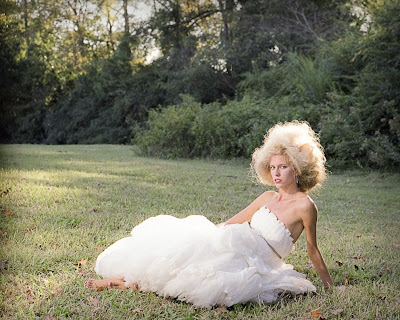
I was lucky to get Jessica to agree to do a bridal session on film. Knowing that she is a working model, I had my work cut out for me. I sent her to my stylist (Kasey at Chadwick Hudson Salon in Macon) for a super crazy hair style and we spent an hour creating images that are unlike anything I've ever done.
These images were captured on Fuji 400H with a Mamiya 645 AF with an 80 f2.8 lens. I tried a new lab. The scans were not to my liking, so these images have been post processed and cropped.




.jpg)
These images were captured on Fuji 400H with a Mamiya 645 AF with an 80 f2.8 lens. I tried a new lab. The scans were not to my liking, so these images have been post processed and cropped.


.jpg)
Subscribe to:
Posts (Atom)
